If you have ever considered why employers give you one tax form upon hiring and a different one in January while looking at a pile of payroll documents, then you are definitely not the only one wondering about it. Form W-2 and Form W-4 are two of the most frequently used employee tax forms in the United States, but they are often mixed up with each other, sometimes even by HR professionals handling onboarding for the first time.
The guide, in simple terms, explains W2 vs W4 forms. It also goes line by line on both forms and shows how they go together in payroll and tax reporting. It even includes the important changes that the IRS is making for the tax year 2026. If you are looking for a reliable check stub generator, online platforms offer a convenient way to create polished pay stubs anytime, anywhere.
Rapid Answer: W-2 vs. W-4 in One Sentence
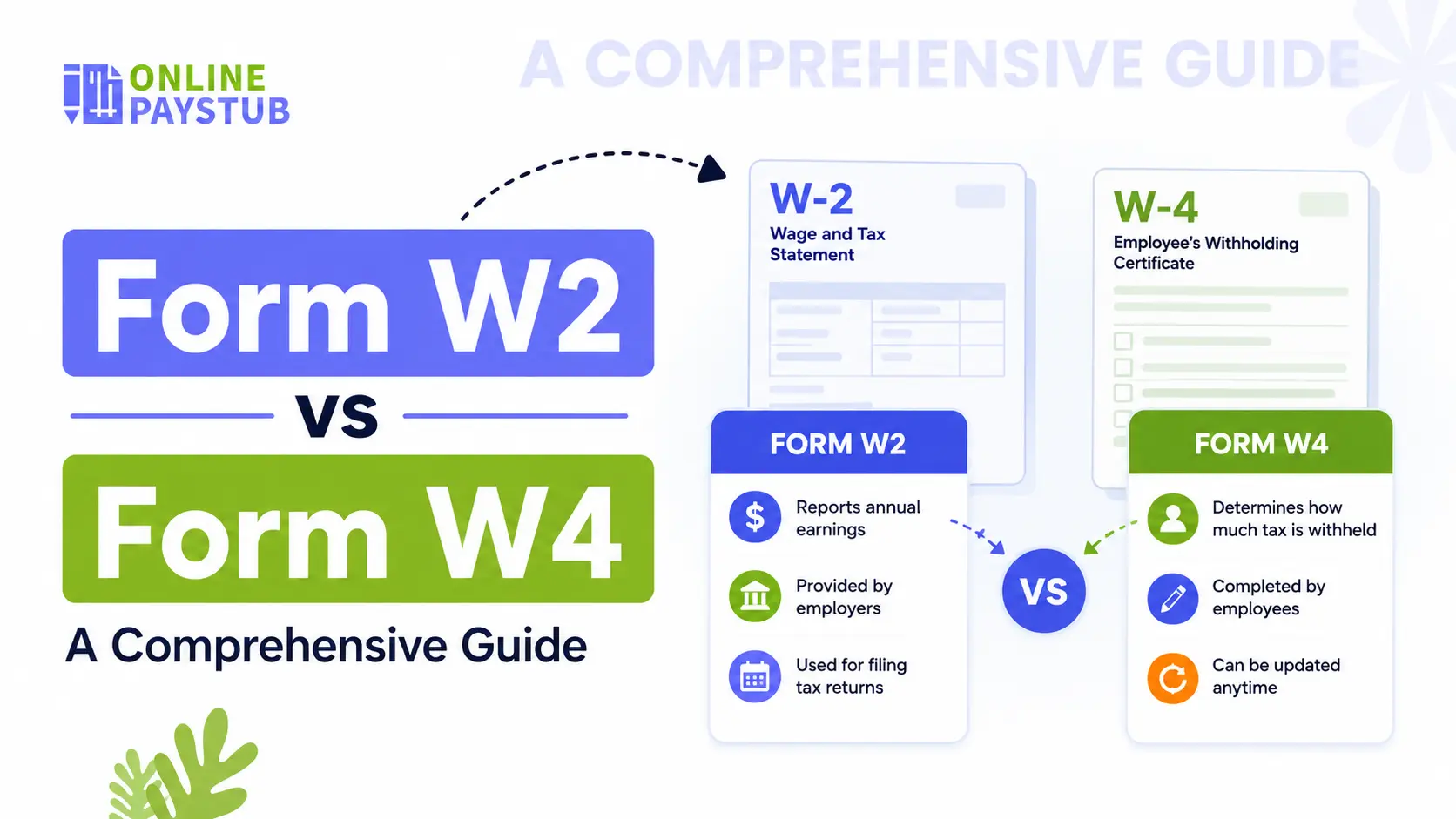
When you start a job, you complete a Form W-4 to inform your employer how much federal income tax should be withheld from your salary. At the end of the year, your employer will provide you with a Form W-2, which shows your total earnings and the amount of tax withheld.
In other words, the W-4 happens at the beginning of the employment relationship and looks forward. The W-2 happens at the end of the tax year and looks backward. One is an instruction; the other is a record. Keep that distinction in mind, and the rest of this guide will fill in the operational and technical details around it.
What is a W-4?
Form W-4, often titled the Employee’s Withholding Certificate, is a document that every new employee completes when they’re hired. The sole purpose is to tell an employee how much federal income tax to deduct from each paycheck.
The W-4 is a form that employees fill out when they start working to tell their employer how much tax to withhold from their paycheck. The W-2, however, is a form that employers send to employees after the end of the tax year, showing the total earnings and the taxes withheld. So, one is a form for getting the job done, and the other is a document providing a summary.
What is a W-4 used for?
A W-4 form has three main functions:
- It establishes filing status for withholding purposes.
- It allows employees to claim dependents and other tax credits that reduce the amount withheld.
- This allows us to account for employees’ additional income, deductions, or additional withholding amounts so that payroll withholding strains as deeply as possible with actual annual tax and legal obligations.
Structure of the 2026 Form W-4
The 2026 Form W-4 is used by employees to tell employers how much federal taxes should be withheld from their paychecks.
Step 1: Insert Personal Information
- Full name
- Address
- Social Security Number
- Filing status: Single or Married filing separately, Married Filing Jointly
Step 2: Multiple Jobs
- Used if you have more than one job at the same time
- Helps ensure accurate tax withholding throughout the year.
Step 3: Claim Dependents
- Enter qualifying children and other dependents.
- Calculates applicable tax credits to reduce withholding.
Step 4: Sign and Date
- Employee signature
- Date signed
- Confirms that the information provided is accurate.
When Do You Fill Out a W-4?
You complete a W-4 in several common situations:
- When starting a new job, as part of the standard new hire tax forms paperwork.
- After a major life event, such as marriage, divorce, birth of a child, or a second job, that changes your tax situation.
- Any time you want to adjust withholding, whether to increase your paycheck by reducing withholding or to avoid a tax bill by withholding more.
What is a W-2?
Form W-2, the Wage and Tax Statement, is the year-end document your employer issues that summarizes your total taxable wages and all taxes withheld during the calendar year.
What is a W-2 used for?
A W-2 form serves as the official record that both the employee and the IRS use to verify income and tax payments. Specifically, the W-2 does the following:
- Reports total wages, tips, and other compensation paid during the year.
- Documents federal income tax withheld, along with Social Security and Medicare tax withheld.
- Reports state and local tax withholding, where applicable.
- Provides the data employees need to file their personal income tax return (Form 1040).
- Gives the Social Security Administration and IRS a cross-checkable record of reported income, which helps prevent underreporting and supports future Social Security benefit calculations.
Structure of the 2026 Form W-2
Boxes 1–6: Federal Income and Payroll Taxes
- Box 1: Wages, tips, and other compensation
- Box 2: Federal income tax withheld
- Box 3: Social Security wages
- Box 4: Social Security tax withheld
- Box 5: Medicare wages and tips
- Box 6: Medicare tax withheld
Boxes 7–14: Additional Earnings and Benefits
- Box 7: Social Security tips
- Box 8: Allocated tips
- Box 9: Reserved for future use
- Box 10: Dependent care benefits
- Box 11: Nonqualified plans
- Box 12: Various compensation and benefit codes
- Box 13: Checkboxes for statutory employee, retirement plan, and third-party sick pay
- Box 14: Other tax-related information provided by the employer
Boxes 15–20: State and Local Tax Information
- Box 15: State and employer’s state ID number
- Box 16: State wages, tips, etc.
- Box 17: State income tax withheld
- Box 18: Local wages, tips, etc.
- Box 19: Local income tax withheld
- Box 20: Locality name
What is the purpose of a W-2 form?
A W-2 form mainly works as a reminder tool for workers so they can correctly prepare their yearly federal and state income tax returns. Besides that, the IRS and local tax offices can cross-check the wages individuals have declared and the taxes they have paid during the year through this document. Normally, by January 31 after a tax year ends, companies have to give W-2 forms to workers.
When Do You Fill Out a W-2?
A Form W-2, Wage and Tax Statement, is not filled out by employees. Instead, it is prepared and issued by employers to report an employee’s annual wages, tips, and tax withholdings.
Employers must complete a W-2 for each employee who received wages during the tax year and provide copies to employees by January 31 of the following year. Employees use the information on their W-2 forms to file their federal and state income tax returns.
If you are an employee, you generally do not fill out a W-2 yourself. However, if you own a business and have employees, you must prepare and distribute W-2 forms at the end of each tax year to comply with IRS reporting requirements.
What is the difference between W2 and W4 Forms?
| Features | W4 Form | W2 Form |
| Full name | Employee’s Withholding Certificate | Wage and Tax Statement |
| Who fills it out | Employee | Employer |
| Who receives it | Employer only | Employee and Social Security Administration |
| Purpose | Tells the employer how much tax to withhold | Reports actual wages earned and taxes withheld |
| Filed with the IRS? | No | Yes |
| Frequency | As needed; reviewed annually | Once per year, per employer |
| Used for | Adjusting paycheck withholding | Filing your personal tax return |
How W-2 and W-4 Work Together in the Payroll Cycle?
Payroll tax forms as they’re two ends of the same process, and understanding how they connect clarifies why accuracy on the front-end matters so much for the back-end. Below is how they both work together:
- Hiring stage: A new employee completes Form W-4 as part of onboarding paperwork, alongside Form I-9 and other employer tax reporting documents.
- Throughout the year: The employer’s payroll system uses the W-4 entries, combined with IRS withholding tables, to calculate federal income tax withholding on every paycheck.
- Year-end: The employer totals all wages paid and all taxes withheld over the calendar year and reports these figures on Form W-2.
- Tax filing season: The employee uses the W-2 to complete their personal Form 1040, reporting income and withholding, and reconciling whether they owe additional tax or are due a refund.
- Adjustment loop: If the employee’s W-2 reveals they owed too much or got an unexpectedly large refund, that’s typically a signal to revisit and update their W-4 for the following year.
Why Employers Care About Both Forms?
From an employer’s perspective, tax reporting, both forms have their share of compliance requirements, but in different ways. A W-4 form is the employer’s contractual authority to withhold the correct amount of federal tax. In case an employer does not collect a W-4 form from a new employee, the IRS instructions state that the withholding should be based on single filing status with no adjustments, which generally results in more withholding than necessary for the employee until an appropriate form is provided.
The W-2 form is equally important for tax compliance. Employers have to submit W-2 forms to the Social Security Administration and give copies to their employees by the end of January. Inaccuracies, in particular under the new rules in 2026 for reporting tips, overtime, and codes for tipped occupational areas, can result in issuing corrected W-2s and possibly facing penalties for not accurately or timely filing. This is another reason why payroll teams are being strongly advised to update their systems before the 2026 filing season.
The new Box 12 codes and the split in Box 14 are not mere changes in appearance; they mandate payroll software to maintain tip and overtime amounts on a separate basis during the year so that the correct figures can be reported when W-2s are issued in January 2027.
Common Misconceptions About W-2 and W-4
- The W-4 determines my tax refund: The W-4 only determines how much is withheld throughout the year. Your actual tax liability is calculated when you file your return; the W-4 simply influences whether withholding ends up higher or lower than that liability.
- I only need to fill out a W-4 once: While it’s true you don’t have to resubmit a W-4 every year, the IRS specifically recommends reviewing it annually, and 2026’s OBBBA-driven changes make this a particularly good year to do so, especially for anyone with tip income, overtime pay, or dependents.
- My W-2 and W-4 should always show the same numbers: They won’t, and that’s by design. The W-4 reflects estimates and elections made at the start of (or during) the year. The W-2 reflects actual, finalized totals. Differences between the two are normal.
- Claiming more dependents on my W-4 is the same as claiming them on my tax return: The W-4 only affects withholding calculations; it doesn’t automatically transfer to your actual tax return. You must still claim dependents and credits properly when filing Form 1040.
Key Takeaways
The major difference between W2 vs W4 is basically about direction and time: the W-4 is a forward-looking and giving instructions document, whereas the W-2 is a backward-looking and reporting document. They are both payroll tax forms mattering a lot in ensuring that federal income tax withholding is accurate and transparent for those employees who wish to keep track of their net pay, as well as for those employers who are obliged to make correct employer tax reporting.
The 2026 tax year will see the most significant changes to both forms due to the One Big Beautiful Bill Act, which has adjusted tip income, overtime pay, dependent credits, and senior deductions, making now a perfect time for employees to think about their W-4 choices again and for employers to check if their payroll systems are prepared for the new W-2 reporting changes that are coming.
FAQs
1) What are the three key differences between W-4 and W-2?
The basic reason for the differences can be summarised as: A W-4 form is filled out by employees when they start a job. The W-4 form will determine the amount of tax to be withheld from every salary. The W-2 form is completed by the employer at the end of the year, disclosing the real wages and withholdings.
2) What is a W4?
A W-4 form, officially known as the Employee’s Withholding Certificate, is a document that employees fill out to inform their employers how much federal income tax to withhold from their paychecks.
3) What is W2?
A Form W-2 is a formal US tax report that employers dispatch both to employees and to the IRS. It illustrates how much you earned throughout the year and exactly how much federal, state, and local taxes were deducted from your payment during the year.
4) How do I know if I am a W-2 employee?
If your organization withholds federal, state, and local benefit taxes from your paycheck all at once and reviews your income on the annual IRS Form W-2, you are a W-2 employee.
5) Do I file my taxes with my W-2?
The data on your Forms W-2 will assist you in doing your tax return. Keep your copies of the forms after filing for your records. In case of e-filing: You are required to give your tax preparer the copies of your Forms W-2 and other income papers before they submit your electronic return to the IRS.
6) What is a W4 used for?
A W-4 form is used by employees to tell their employer how much federal income tax should be withheld from their paycheck. The information provided on the form helps ensure the correct amount of tax is deducted throughout the year.
7) Is a W-2 the same as a tax return?
Form W-2 reports wages and taxes withheld; Form 1040 is the individual income tax return used to report total income and reconcile tax due or refund.
8) Why W4 vs W2?
Form W-2 and Form W-4 are federally required IRS tax forms; Form W-4 is completed by employees and used by employers to calculate how much earnings tax to withhold. The reason for the Form W-2 on the alternative side is filing worker wages last year, and what kind of taxes were withheld.
9) How does the W-4 affect my taxes?
Updating your W-4 changes how much federal tax your employer withholds from each paycheck. Increasing your withholding typically raises your tax refund or lowers what you owe at tax time, but it reduces your take‑home pay.
10) Can I claim exempt on my W-4?
An employee can also use Form W-4 to tell you not to withhold any federal income tax. To qualify for this exempt status, the employee must have had no tax liability for the previous year and must expect to have no tax liability for the current year.