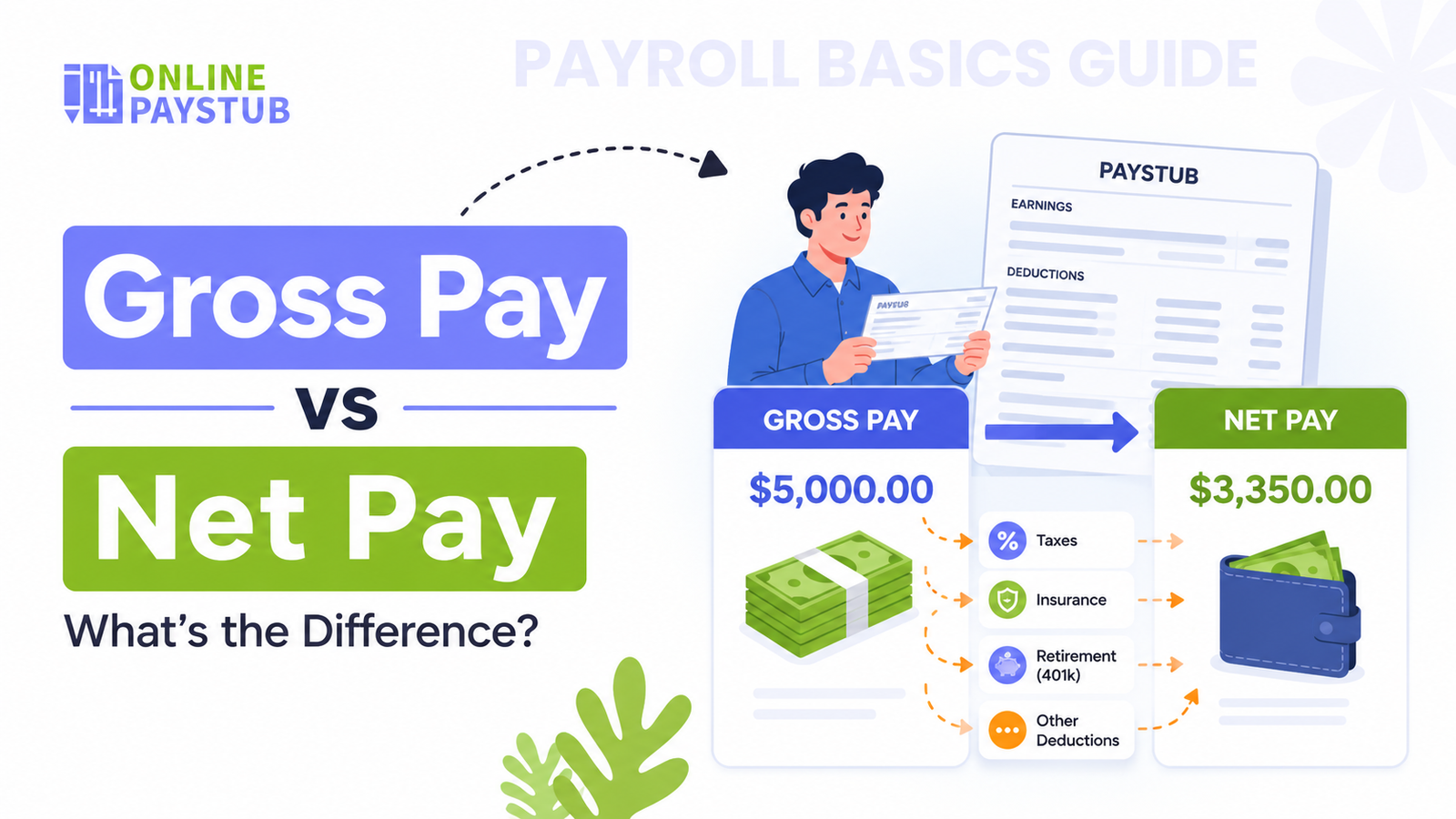
When you receive a paycheck, the amount you earn and the amount you actually take home are often not the same. This is where understanding gross pay vs net pay becomes important. Gross pay refers to your total earnings before any deductions, while net pay is the amount you receive after taxes, insurance premiums, retirement contributions, and other deductions have been subtracted.
Understanding this difference between gross pay and net pay isn’t just about satisfying curiosity; it’s the foundation of every smart financial decision you’ll ever make, from budgeting and saving to negotiating your next salary. If you are looking for a reliable online paystub generator tool, choosing our accurate tool can help you generate detailed pay stubs quickly and efficiently.
This guide breaks down gross income and net income, explaining every deduction that stands between your salary and your bank account, and shows you exactly how to calculate your own take-home pay in 2026.
What is Gross Income?
Gross income represents the whole of your remuneration before any deductions are made. It is the figure that your employer has committed to paying you, be it the annual salary specified in your offer letter or the hourly rate multiplied by the number of hours you have actually worked. In fact, payroll departments sometimes use terms like gross salary, gross wages, or gross payroll to refer to it.
What is Net Income?
Net pay, also known as take-home pay, refers to the amount of money left with you after subtracting any compulsory and voluntary deductions from your gross pay. It is the money that gets deposited into your bank account on payday.
What is included in Gross Pay?
Wages & Salary
- Base salary (annual ÷ pay periods) or hourly rate × hours worked
- Overtime pay (typically 1.5× regular rate for 40+ hours/week)
Additional Earnings
- Bonuses and commissions
- Tips (reported)
- Shift differentials
- Severance pay
- Paid time off (vacation, sick) is paid out
- Car allowances and certain taxable fringe benefits
What is included in Net Pay?
Net pay = Gross Pay minus all deductions. So it reflects your gross minus:
Mandatory Tax Deductions
- Federal income tax (withheld per W-4 + IRS brackets)
- State and local income tax (varies by location)
- Social Security tax: 6.2% up to $184,500 wage base (2026)
- Medicare tax: 1.45% on all wages (+ 0.9% surtax above $200,000)
Pre-Tax Benefit Deductions
- Health, dental, and vision insurance premiums
- 401(k) / 403(b) traditional contributions
- HSA / FSA contributions
Post-Tax Deductions
- Roth 401(k) contributions
- Life/disability insurance
- Union dues
- Wage garnishments
Gross Income vs Net Income
| Factors | Gross Income | Net Income |
| Definition | Total earnings before deduction | Earnings after all deductions are made |
| Also known as | Gross salary, Gross income | Take-home pay, net pay |
| Appears on a pay stub | At the top | At the bottom |
| Used for | Loan applications, benefit eligibility | Budgeting, day-to-day spending |
| Include taxes? | Yes | No |
What gets deducted between Gross and Net Pay?
The gap between gross pay & net pay is filled by a combination of voluntary and mandatory deductions. Below is a complete breakdown:
1. Federal Income Tax
Federal income tax is unquestionably the main withholding for a typical employee. The IRS works with a progressive bracket system, which simply means the higher your income, the higher your marginal tax rate. For 2026, federal tax brackets will range from 10% to 37%, and these rates are.
Your W-4 selections determine the specific federal income tax withholding from each of your paychecks. They are your filing status, dependents, and any additional withholding request you’ve made. That is why the net federal tax withholding of two employees with the same gross salary can be different.
2. FICA taxes: Social Security and Medicare
FICA taxes are split into two sections, and both you and your employer pay a share:
- Social security tax: Social Security Tax (OASDI): Employees pay 6.2% of their gross wages toward Social Security taxes. In 2026, this tax applies only to the first $184,500 of annual earnings, an increase from the $176,100 wage base limit in 2025. Once your year-to-date earnings exceed $184,500, Social Security tax is no longer withheld from your paycheck for the remainder of the year.
- Medicare tax: A Medicare tax of 1.45% is deducted from every paycheck, and there is no income cap. If your annual earnings exceed $200,000, an extra 0.9% Medicare tax is withheld on the amount above that limit. Unlike the regular Medicare tax, this additional tax is paid only by the employee and is not matched by the employer.
3. State and Local Income Taxes
Local income tax differs greatly from place to place. Most states impose their own income taxes, which can be as low as 3% or as high as 13% (California and New York in particular). On the contrary, 9 states, such as Texas, Florida, and Nevada, do not levy state income taxes, thereby greatly increasing the take-home pay of the employees in these states.
See more: Cost Of Living In Various States
4. Pre-Tax Benefit Deductions
These deductions happen before your taxable gains are calculated, which means they shrink your tax bill even as significant investment gains:
- 401(k) contributions: In 2026, the annual contribution limit is $24,500, with an enhanced catch-up of up to $11,250 for workers aged 60–63.
- Health, dental, and vision insurance premiums: Employer-sponsored plans are typically deducted pre-tax.
- HSA contributions: Pre-tax and triple-tax advantaged.
- FSA contributions: Pre-tax, use it or lose it annually.
5. Post-Tax Deductions
These come out after taxes are calculated, which do not reduce your tax burden:
- Roth 401(k) contributions: Taxed now, grow tax-free
- Life and disability insurance: In some plans
- Union dues
- Wage garnishments: Court-ordered deductions for child support, unpaid taxes, or student loan defaults. If a garnishment order is in place, your organization is legally required to withhold and return it.
Why Gross Pay & Net Pay matter?
Budgeting
Always plan your budget based on your net income. Many individuals end up allocating excessive amounts to rent, car installments, and subscriptions while considering their gross salary only. They only realize later that they do not have enough cash each month to cover their expenses. Neither your landlord nor your grocer will take I earn $72,000 yearly as payment. They want the money that is really in your bank.
Job Offer Comparisons
The same gross salary for two different job offers can cause quite different net incomes, given the state taxes, cost of benefits, and retirement match differences. For example, a $70,000 offer in Austin, TX (where there is no state income tax) compared to a $70,000 offer in Portland, OR (where state income tax goes up to 9.9%) will give you a much different take-home pay.
Loans and Mortgage Applications
Lenders generally qualify you based entirely on gross income because it’s a standard, consistent, wide variety yet you repay debt from your internet earnings. Understanding both numbers allows you to evaluate what you can truly have enough money for.
See More: Increase Your Eligibility For a Home Loan
Retirement Planning
Your 401(ok) contributions are out of gross pay. Understanding this flirtation can optimize contributions, especially in 2026, in which the restriction increased to $24,500, and SECURE 2.0 catch-up provisions are in full effect for employees 60–63.
How to read your Pay Stub?
1. Gross Pay: Top of the stub, total earnings for the period
2. YTD Gross: Year-to-date total, useful for tracking against wage caps
3. Pre-Tax Deductions: Health premiums, FSA/HSA
4. Federal and State Tax Withholding: Itemized by type
5. Post-tax Deductions: Roth contributions
6. Net Pay: Final figure at the bottom
Key Takeaways
The main difference between gross pay and net pay isn’t simply a payroll technicality; it is, in fact, the difference between your employer’s payment and what you can actually live on. While gross income is the highlight, net income is the one everyone lives with.
Once you get to know every deduction from the two federal taxes, FICA, state withholding, benefit contributions, and so on, you equip yourself to manage your financial situation. You will be able to negotiate more intelligently, plan your budget rightly, make the most out of your choices, and no longer be caught off guard every payday.
FAQs
1) What is gross salary meaning?
Gross earnings are the entire amount an employee earns before any taxes, benefits, or other payroll deductions are withheld.
2) What is net salary meaning?
Net earnings are the amount of cash that an employee honestly receives, and finally, the deductions are taken from their gross earnings.
3) What is the difference between gross income vs net income?
Gross pay refers to the total amount you receive before taking authorities or any other deductions. Net pay (or take-home pay) is the amount of money you will be left in your paycheck or financial institution account, whichever case deductions are made.
4) Is it better to be paid gross or net?
Gross revenue is your ordinary income before taxes and deductions, and is useful for business negotiations. Net pay is your actual take-home cash after deductions, which you have to use for day-to-day budgeting.
5) Why is my gross pay less than my net pay?
Your gross revenue is your total earnings before any deductions. This should be consistently better than your online pay (take-home pay) because it works from a baseline from which mandatory taxes and voluntary deductions are subtracted.
6) How much is $50,000 net in gross?
If you earn $50,000 in step with the year in California, USA, you will pay $10,242 in taxes. In California, USA, your net salary after taxes is $39,758 for the corresponding year, or $3,313 for the month, step by step.
7) What does $5000 net mean?
$5000 net means you take home exactly $5,000 in actual money after all deductions are taken out. This is your take-home pay.
8) How much is $70,000 a year weekly?
A $70,000 annual salary breaks down to $1,346.15 per week (gross pay) before taxes and deductions, assuming a standard 52-week working year.
9) What’s better, net pay or gross pay?
Net salary is better for establishing your day-to-day non-public price range, while gross salary is better for career negotiations and assessing your ordinary benefits. One is not always objectively higher than the opposite; As opportunities, they engage in high-quality monetary operations.
10) What is the difference between net pay and gross pay in CTC?
The CTC consists of direct, indirect, and savings benefits, while the gross salary is your normal earnings before tax deductions, and it is the net income that demonstrates your real income potential.