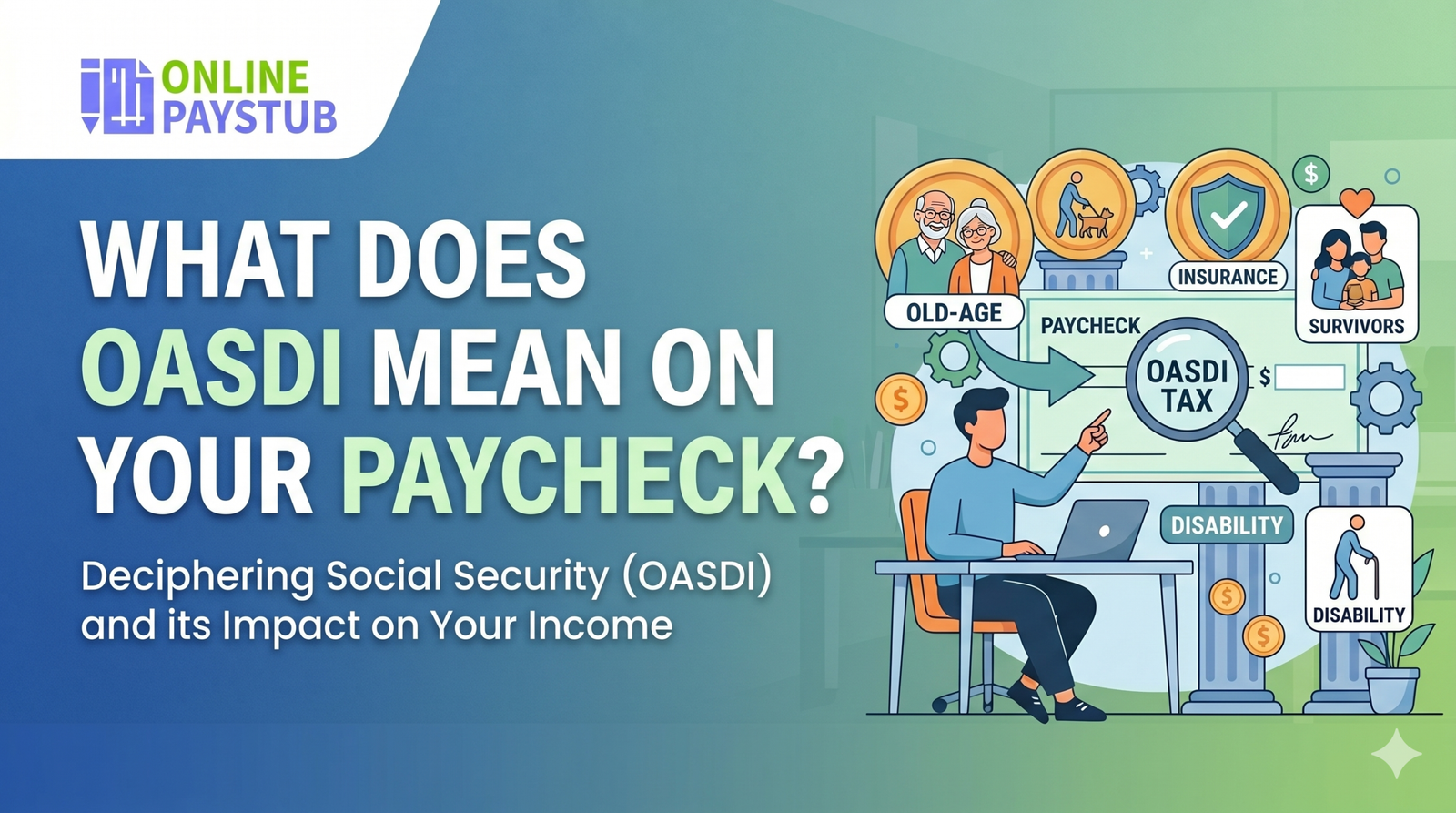
If you have ever looked closely at your paycheck and then noticed a deduction labeled OASDI, you’re not alone in thinking what it means. OASDI, short for Old-Age, Survivors, and Disability Insurance, is a federal tax that funds the U.S. Social Security program. This program provides financial support to retirees, people with disabilities, and the families of deceased workers.
In this guide, we will be breaking down everything about OASDI and how it impacts your earnings. In any case, if you are in need of creating professional paystubs for proof of income, you can just rely on free paystub generator.
What is OASDI tax?
OASDI on a paystub stands for Old-Age, Survivors, and Disability Insurance. It is the legal name for the U.S. Social Security Program. It is a mandatory federal program that is funded via FICA and provides monthly benefits to disabled individuals and surviving members of the family of deceased workers.
What is OASDI on my paycheck?
If you view OASDI on my paycheck, it is just another way that shows Social Security taxes. People pay a part of their earnings during their lives. This support helps today’s beneficiaries. Others will get the same when it is their turn to retire or when they face disability in their lives.
When the money is collected from the OASDI federal tax, it is used to finance the monthly retirement check. The Social Security Administration generally manages it accordingly. The tax is used to pay Social Security benefits to current retired workers and people who are receiving disability benefits.
Is OASDI tax mandatory?
Yes, the OASDI tax is compulsory for most of the U.S. employees and employers. It is a federal requirement that has 6.2% deducted from the employee’s paycheck and is matched by employers up to an annual wage base limit.
Major Details About the OASDI Tax Mandatory
Mandatory Participation
Most U.S. employees must pay OASDI tax, and employers are legally required to withhold it from wages.
Purpose
OASDI tax funds the Social Security program, which provides:
- Retirement benefits
- Disability income
- Survivor benefits for families of deceased workers
Tax Rate & Limit
Employee: 6.2%
Employer: 6.2%
Total (FICA): 12.4%
Self-employed (SECA): 12.4%
Exemptions
Some individuals may be exempt, including:
- Certain foreign workers / nonresident workers
- Members of specific religious groups
- Some government or international organization employees
What does OASDI stand for?
OASDI stands for Old-Age, Survivors, and Disability Insurance. Whether you know it or not, you’re probably paying OASDI tax, so it is important to learn about it.
What is OASDI on paycheck?
OASDI on paycheck stands for Old-Age, Survivors, and Disability Insurance. When you see it listed as a deduction on your paycheck, it means a part of your earnings is being taken out and is contributed to the federal Social Security Program.
This tax fund benefits:
- Retirement income
- Disability benefits
- Survivor benefits
OASDI is not just a random deduction; it is a mandatory contribution to the Social Security program.
OASDI for Self-Employed and Disabled Workers
OASDI for Self-Employed Individuals
If you’re a self-employed individual, you do not have an employer to split the tax, so you pay the full amount yourself. You pay 12.4%, which gets applied to your net earnings. Below we have mentioned the important benefits of it:
- You earn Social Security Credits
- You qualify for disability and survivor benefits
- You can deduct half of the self-employment tax while filing income taxes
OASDI for Disabled Workers
OASDI funds Social Security Disability Insurance is a program for people who are not able to work due to serious medical conditions. Below, we have mentioned how the benefits work:
- Monthly payments are based on lifetime earnings
- Benefits continue as long as the disability persists
- After reaching retirement age, SSDI converts to retirement benefits
How does Online Paystub help?
Online Paystub smoothens payroll running, making sure there are accurate tax withholdings and that tax compliance is maintained. Backed up with a solid check stub maker free provides you with peace of mind, which updates you if there are any key changes.
Key Takeaways
OASDI on your paycheck refers to the social security tax deducted from your earnings to fund retirement, disability, and survivor benefits. While it reduces your take-home pay today, it plays a crucial role in securing your financial future. Understanding what is OASDI on paycheck helps you stay informed, avoid confusion, and better manage your overall finances.
FAQs
1) Why am I paying OASDI tax?
You are paying OASDI tax because it is a mandatory federal payroll tax that funds Social Security benefits for surviving spouses and disabled workers.
2) Do I get OASDI tax back?
OASDI is a non-refundable thing because it funds future benefits.
3) What does OASDI stand for?
OASDI stands for Old-Age, Survivors, and Disability Insurance.
4) What is OASDI on paycheck?
OASDI on paycheck means you are paying into the federal program that provides monthly income for retirees, qualifying individuals with disabilities, and the surviving family members of employees who have passed away.
5) What is OASDI deduction?
OASDI deduction is 6.2% payroll tax deducted from employee paychecks to fund Social Security.
6) What is OASDI on paystub?
OASDI is a mandatory federal deduction that is taken from your paycheck to fund benefits for disabled individuals and surviving family members of deceased workers.
7) Is OASDI the same as Social Security?
OASDI is a formal term for Social Security. When you see OASDI on your pay stub, it means you are contributing to the Social Security System.
8) Can I opt out of OASDI tax?
For most employees, OASDI is mandatory and cannot be opted out of.
9) Who is eligible for OASDI tax?
Self-employed individuals and U.S. employees are eligible for a set wage base.
10) How to avoid OASDI on paycheck?
Avoiding OASDI is not possible for most employees, as it is a compulsory 6.2% FICA tax.