Ever seen a job offer that said they want to hire you as a 1099, while others say they’ll give you a W2 position? This is one of the biggest sources of confusion when it comes to hiring and freelancing, and quite frankly, it’s something that most people don’t really ever get a straight answer on.
So let’s clear it up. Short version: the thin line between who owns the work, who pays taxes on it, and what happens when tax season rolls around. That happens when you actually want to create your paystub via a paystub generator.
What is W2?
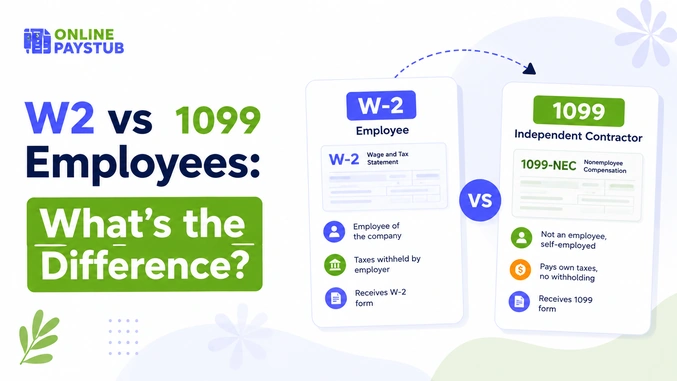
If you are a regular employee, when the year-end comes around, an employer sends you a W2 form as their business tax form. It displays your gross wages and what amount was previously retained for federal, state, Social Security, and Medicare taxes. Your employer took care of that for you all year, a little from every paycheck.
Receiving a W2 indicates you are recognize as an employee, not an independent contractor. That does come with some protections as well; minimum wage, overtime, and unemployment insurance do not apply to independent contractors.
What is 1099?
1099 form (like 1099-NEC nowadays) is a tax form that a business would send you if you are an independent contractor and earned $600+ in a year from them. No taxes are taken out. You receive all the funds you were paid, and it is up to you to allocate money to pay the IRS yourself in amounts that usually get divided into quarterly slices.
If you get a 1099, the IRS considers that you are self-employee, even if it might not feel like you are. In addition to ordinary income tax, you are liable for self-employment tax, which represents both the employer and employee parts of Social Security and Medicare.
What is The Difference Between W2 and 1099
The biggest W2 and 1099 is on a day-to-day work basis, which is who calls the shots, who pays for what, and how much stability you may be able to rely upon after getting tax forms themselves. This is how they both compare; let’s check the 1099 employees vs. W2 table.
| Category | W-2 Employee | 1099 Contractor |
| Taxes | Employer withheld automatic taxes | Pay estimated tax themselves, and pay self-employed taxes (both halves of Social Security and Medicare) |
| Who’s in charge | Employer’s direction – for example, hours of work are set by the employer | Has a show of its own; sets own schedule, and how the work gets done |
| Benefits | Usually receives health insurance, PTO, retirement matching, and unemployment coverage. | As they do not get any of that from the company hiring them to cover their own insurance and retirement savings. |
| Cost to the business | It costs more than just salary; payroll tax, workers’ comp, and often benefits piled on top. | Generally cheaper for the business, since there’s no payroll tax or benefits obligation. |
| Stability | Less risky stable paychecks, legal protections, unemployment insurance if it goes sideways | Having more business than you can handle one month and not enough the next |
So… is it up to the employer to decide?
No, and this trips a lot of people up. A company can’t just decide to turn someone into a “1099 employee” because it’s less expensive. There are guidelines for this from the IRS; believe it or not, they can be boil down to just three questions:
- Behavioral control – Does the company dictate when, where, and how to do the job?
- Financial control – Who provides the tools? Who covers expenses? How is pay structure?
- Relationship – Does the contract imply an indefinite staff relationship or is there a defined undertaking?
If someone’s working set hours, using company equipment, and being closely supervise, they’re a W2 employee; even if the paperwork says otherwise. Misclassifying employees as contractors is a real problem, and it can lead to back taxes, fines, and a very unpleasant audit.
What About Paystubs?
Now, here is something that does not get talk about enough: as a W2 employee, you receive a paystub every pay period detailing your gross pay, deductions, and then net. 1099 contractors typically do not get anything anywhere near that. Payment is made by invoice or direct deposit; without any analysis, there are no documents that prove it.
This is all true until you need to provide income verification for a rental application, a vehicle loan, a mortgage, anything. Many freelancers hit this particular wall. However, if that is you, simply create a pay stub by using a good online pay stub generator tool.
Which one is “better”- W2 or 1099?
It depends on where you are with work.
W-2 Work is going to be a lot more comfortable for you if you like job security, employee benefits, and not having to think about quarterly taxes. If you want to enjoy the flexibility of working with multiple employers and can manage your taxes/insurance by yourself, 1099 work can provide a level of freedom regular employment just can’t.
Neither is objectively superior; they both cater towards different types of people and different types of work.
Bottom line
W-2 and 1099 aren’t just tax forms: they are two fundamentally different styles of work with distinct tradeoffs around taxes versus benefits and flexibility. As an employer, the distinction is important legally. Knowing which one you are is critical to planning for taxes and benefits, and if you’re a 1099 contractor, when the time comes that you have to prove your income!
FAQs:
1) What is the difference between W-2 and 1099?
W2 is the form for employees; taxes are withheld by the employer. A 1099 applies to independent contractors, and they deal with their own taxes.
2) Can a company just choose which one to use?
Not legally. Preference or cost has nothing to do with it but rather the actual working relationship and how much control the company retains over the work.
3) Do 1099 workers get paystubs?
Often not from the client paying them, but many contractors create their own for income documentation in loans or leases or just for the fun of it.
4) W-2 or 1099 — which pays more?
Independent contractors and freelancers often will require an hourly or project rate higher than what you would pay to a regular employee in order to offset not only the absence of benefits, but the taxes these workers must pay on their own. Of course, it “pays more” at the end is a relative term depending on how you account for that cost.
Also Check:
Form W2 vs W4: Understanding the Differences?
Gross Pay vs Net Pay Explained: How Your Paycheck Really Works?